ShadeTree Digital

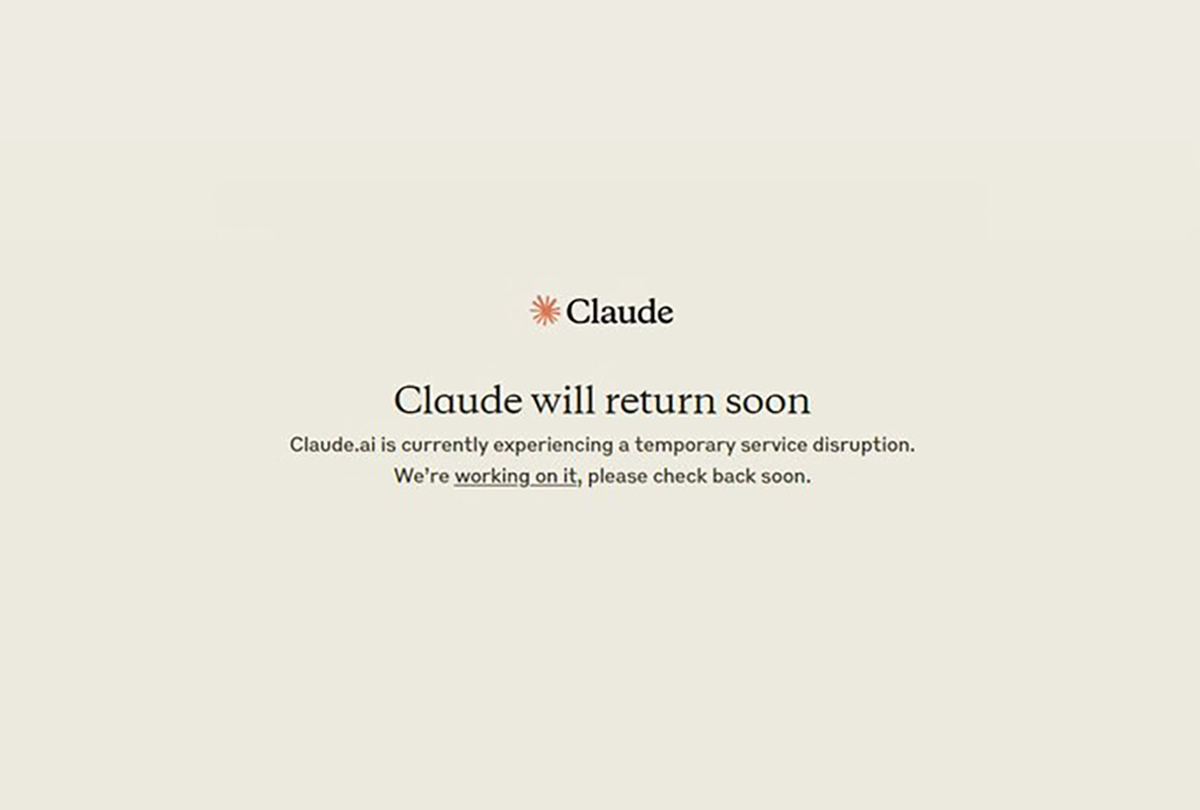
Claude went down, And everyone’s talking about the wrong thing.

Rabb Con Content Team

March 3, 2026

Editorial Policy

All of our content is created by subject matter experts with decades of technology and business systems experience and structured by writers and educators for clarity and ease of use. Every article is fact-checked to ensure accuracy, and we remain objective when analyzing tools, strategies, and methodologies so the information shared is practical, reliable, and grounded in real-world application.

Claude Crashed today

TL;DR

The Claude Outage Reveals a New Kind of Failure

Claude went down today, and everyone is talking about infrastructure, leadership, and failed assumptions. What I found most interesting about the coverage, however, is that nearly every analysis followed a rule we can now assume no longer applies: keep politics out of the workplace.


It’s one thing when social change results in funding shifts or reputational damage. It’s another when a single social moment affects businesses worldwide in real time.


Let’s get into it.

Need a Primer? Read this first:

A Political Decision Triggered a Real-Time Business Disruption

Reports across multiple outlets confirmed what many suspected as it unfolded: 

That isn’t simply a technology failure or a leadership misstep either. This incident exposed a new variable that system designers must now consider.

Engineers Did Their Jobs — The Old Assumptions Did Not

Claude’s engineers likely did exactly what they were supposed to do. Systems are traditionally designed around predictable aggregates of demand with additional scaling buffers layered on top, an approach that has worked reliably for decades because growth historically followed measurable patterns. The problem is that those models assume adoption behaves predictably, and that assumption may no longer hold.

Use visual aids like tables, graphs, infographics to further prove your authority on this topic.

This Outage Belongs in a Category That Does Not Exist Yet

This type of disruption differs fundamentally from familiar outages: the AWS/Kiro disruption, Meta’s platform outages, or last year’s CrowdStrike incident affecting Windows systems. Those failures originated internally, caused by technical errors, updates, or operational mistakes.

The Claude event was different. No engineer pushed faulty code. No deployment failed. The infrastructure functioned as designed. Society simply overwhelmed it.

This may represent a new category of outage, one that does not yet have clear terminology. It is neither technical failure nor human error in the traditional sense. It more closely resembles a structural stress fracture caused by collective human behavior at scale.

Guide

Grab our 5-step audit guide to find your revenue leaks

We’ve put together a simple concise method to determine where your leads may be running off instead of turning into revenue . 

Bluesky Warned Us — The Industry Just Called It a Traffic Spike

We have seen early versions before. Bluesky experienced similar outages following the 2024 election and again during the Trump–Musk backlash that drove large user migrations away from X. Each time, the explanation was reduced to a “traffic spike,” and the industry moved on without redefining the phenomenon. Perhaps it shouldn’t have.

The Claude outage was less a failure than an unplanned stress test. It exposed an assumption the industry has quietly relied on: that technology and society operate on separate tracks. That assumption may now be expired.

The real question moving forward is not whether social forces will influence infrastructure, but how systems will be designed to withstand them. What new assumptions will guide architecture decisions? And how will platforms evolve to remain stable in a world where cultural momentum can move faster than code deployments?

Claude went down, And everyone’s talking about the wrong thing.

CROS™ Fractional vs. CROS™ Managed

See the difference and choose what’s best for your business.

Related Articles